Descripción
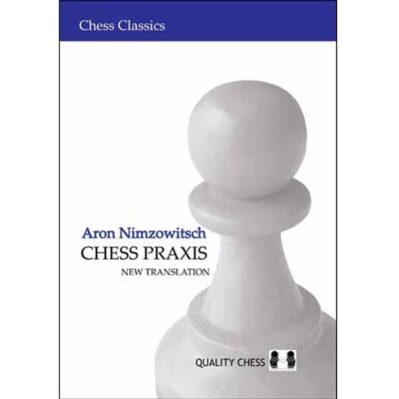
Chess Praxis is a superb collection of Aron Nimzowitsch’s best games annotated by the great man himself, but it is even more than that. Nimzowitsch and his hypermodern ideas had a huge
influence on modern chess thinking.
Nimzowitsch first expounded his views in My System. In his follow-up Chess Praxis he demonstrated and explained how his concepts worked in his own games.
This is a completely new translation of Nimzowitsch’s classic work, which will allow the reader to appreciate influential ideas explained in modern language.
Aron Nimzowitsch was one of the greatest chess players of the 1920s and 1930s, ranked just behind the famous World Champions Alekhine and Capablanca.
His reputation as an author is higher still.
Chess Praxis
T his leads to excellent results in modern tournament praxis. The reason is that up until now it has not been well known that under all circumstances the control of the central
squares is a strategic necessity; quite often even experienced players simply “run away” from the centre. But in each individual case we must make absolutely sure that any neglect
of the central area by the opponent is really punished.
Centralization
Sins of omission as far as the centre is concerned arise because the player is not in the habit of paying attention to the needs of strategy (that is – in other words – strategic carelessness)
or because he develops a passion for the flank attack! In the first case, our opponent lets us take the centre away from him and in the second he voluntarily concedes it to us in order
to try his luck with a bold sortie down the wing.
Chess Praxis
But a flank attack only has a real chance of success when the centre is closed or can be held stable with a minimum of forces. If the latter is not the case, then the attack fails because of
a lack of forces. How can it be possible to successfully link a difficult attack with the heavy demands of a difficult defence? Game 3 illustrates this clearly.

Sample pages



Valoraciones
No hay valoraciones aún.