Descripción
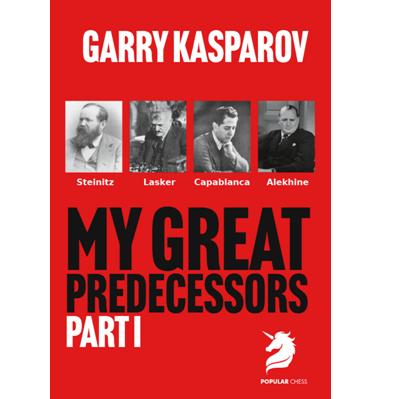
My Great Predecessors 1 Steinitz, Lasker, Capablanca & Alekhine is rereleased in paperback and hardcover, enhanced in every way, with high-quality print, modern fonts and
an upgraded visual style.
Part I covers the dawn of modern chess and the reigns of the first four World Champions: Wilhelm Steinitz (1886–1894), Emanuel Lasker (1894–1921), José Raúl Capablanca (1921–1927),
and Alexander Alekhine (1927–1935 and 1937–1946).
Winner of the ECF Book of the Year 2003
My Great Predecessors 1
Garry Kasparov, the 13th World Chess Champion (1985–2000) “is the greatest player who’s ever lived” – Magnus Carlsen
For quite some time I have been wanting to write a book on the new and modern history of chess. And moreover, deviating from the traditional approach,
to demonstrate the continuous progress of the game through the play of the world champions. Since it is this elite group of super-stars (only 14 in 117 years!)
Steinitz, Lasker, Capablanca & Alekhine
that has made the greatest contribution to chess: to win the supreme title, they had to overcome the best of the best, discover something new, and catch highly experienced
and talented opponents unawares. According to offi cial legend, a slow war game not unlike chess originated nearly 2,000 years ago in India, and, undergoing slight changes,
made the endlessly long journey through the south of Central Asia, Persia and the Arab countries of the Middle East, to the Iberian Peninsula. However, the ‘Indian’
version of the origin of chess became known to Europeans only at the end of the 17th century. Only one thing can he stated with certainty:
My Great Predecessors 1
modern chess originated in the 15th century on the Mediterranean. And this is already a purely European invention – an intellectual game, modelling psychological warfare.
The best chess masters of every epoch have been closely linked with the values of the society in which they lived and worked. All the changes of a cultural, political and psychological
background are refl ected in the style and ideas of their play. This deep connection can be traced back a long time. Was it not logical that, in the era of the Renaissance, in the 15th-17th
centuries, chess developed most rapidly in Spain and Italy? Was it an accident that the fi rst maestro, who tried to create a theory of positional play,
lived in the epoch of the Enlightenment and of the philosophy of rationalism – the great François-André Philidor (incidentally, a well-known composer and a friend of Diderot)?
And remember the slogan that he proclaimed in the middle of the 18th century – ‘The pawns are the soul of chess!’ Do we not hear in this echoes of the coming Great French Revolution?

Sample Pages



Valoraciones
No hay valoraciones aún.